From to ZETA
A B C D E F G H I J K L M N O P Q R S T U V W X Y Z

Simulation-Driven Concept Design for a Large-Scale mAb Facility

Validating capacity, technology selection, and facility performance before any equipment was ordered.
Modeling every unit operation in INOSIM before equipment was specified surfaced the capacity bottleneck, reframed technology selection across single-use and stainless options, and supported informed investment across three identical production lines.

The Customer Challenge

Most large-scale bioprocessing facility decisions get made on assumption. Equipment gets specified against vendor data sheets. Foundations get poured against best-guess footprints. Modeling — if it happens at all — happens after the capex is already committed. By the time the asymmetries between unit operations show up in operation, the geometry of the building is locked.

For a customer planning a large-scale monoclonal antibody facility built around three identical production lines, that sequencing was the problem to solve. They needed to know — before any equipment was ordered or any vendor was scoped — whether the design would actually deliver the throughput it promised, where the bottlenecks would be, and which technology choices would compound the cost-of-goods rather than reduce it. The decisions that shape COGS on a biologics facility are made years before the first batch. They needed those decisions made on data.

The ZETA Approach

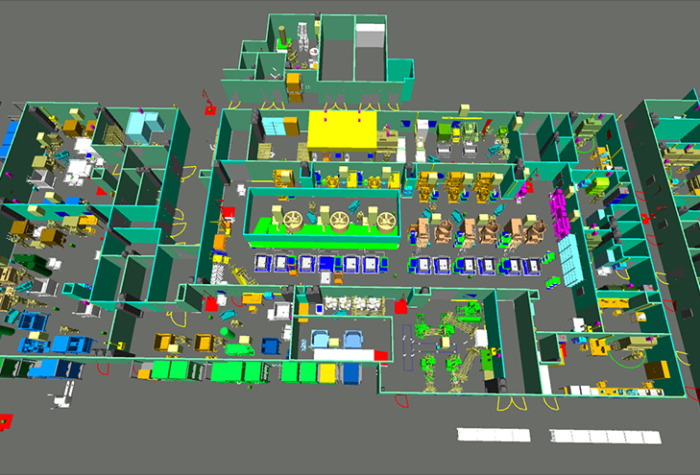
ZETA built the concept design and modeled it end-to-end in INOSIM. Every unit operation across the three identical production lines was modeled individually — fermentation, harvest, capture, polishing, formulation, buffer preparation — then run together as one connected system. Single-shift, multi-shift, and campaign scenarios were each stress-tested against the model.

The point was not to validate a design that had already been drawn. The point was to find out what the design should be in the first place — and to surface the asymmetries early enough that the capex decision could be informed by them rather than blindsided by them.

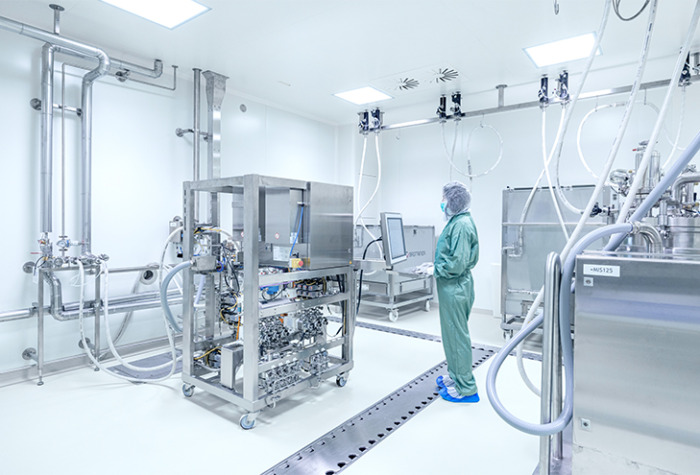
The same engineering team that produces the concept also fabricates the process equipment and develops the automation. Three disciplines — design, fabrication, automation — under one company. The handover most facility projects lose months to doesn’t exist: the model that informs the concept is the same model that proves the equipment will perform the way the concept intends.

Key Engineering Decisions

The simulation surfaced a 46-point gap in unit-operation utilization. Upstream ran at 91 percent. Downstream sat at 45 percent. That asymmetry reframed every decision that followed.

Equipment specification became a rightsizing exercise. Where upstream was the constraint, capacity additions there carried the cost-of-goods weight; where downstream was idle, larger or duplicated equipment added capex without earning it back. Buffer preparation — often the invisible downstream constraint in facility designs — emerged as the choke point that needed restructuring before line count was finalized.

Technology selection was made unit-operation by unit-operation. Single-use, stainless steel, and hybrid configurations were each evaluated against the modeled bottleneck — not against a generic preference. Some unit operations clearly favored single-use economics; others justified the capex and CIP overhead of stainless; several were better served by hybrid approaches that matched campaign-length economics to operational reality. Each call was tested in the model before it was carried into the equipment specification.

Results and Outcomes

The customer received a concept design package grounded in simulation data, not vendor assumptions. The technology decision framework gave the customer a defensible basis for each single-use vs. stainless choice — backed by the modeled cost-of-goods at the actual throughput.

Most importantly, investment decisions were made on data. The capex commitment came after the system had been proven on paper, with technology choices, equipment sizes, and line configurations all stress-tested against the bottleneck the simulation revealed. The expensive surprises that typically surface in commissioning surfaced in the model instead — where they cost engineering hours, not millions in retrofit.


Optimizing large-scale bioprocessing facilities requires simulating each unit operation individually, identifying system-level interactions, and addressing the challenges they bring to facility design as early as possible.


That level of rigor is what differentiates a thoughtfully engineered solution from an expensive assumption. The full study walks through the modeling methodology, the decision logic at each unit operation, and the cost-of-goods analysis behind every technology call.

Download the full study.
See the model.

Download the full case study to see how process simulation, concept design, and technology selection helped optimize facility capacity, reduce equipment requirements, and support more confident investment decisions for a large-scale monoclonal antibody manufacturing facility.

Please complete the form to receive the requested content.


The form cannot be displayed due to your browser settings. Please contact us directly via marketing-us@zeta.com or adjust your browser’s tracking settings.

    By submitting, I agree to the Privacy Policy.

    download file

    We use your data exclusively in accordance with our Privacy Policy.

    Show content